Sun news August 26: Big chunk of solar stuff coming to Earth
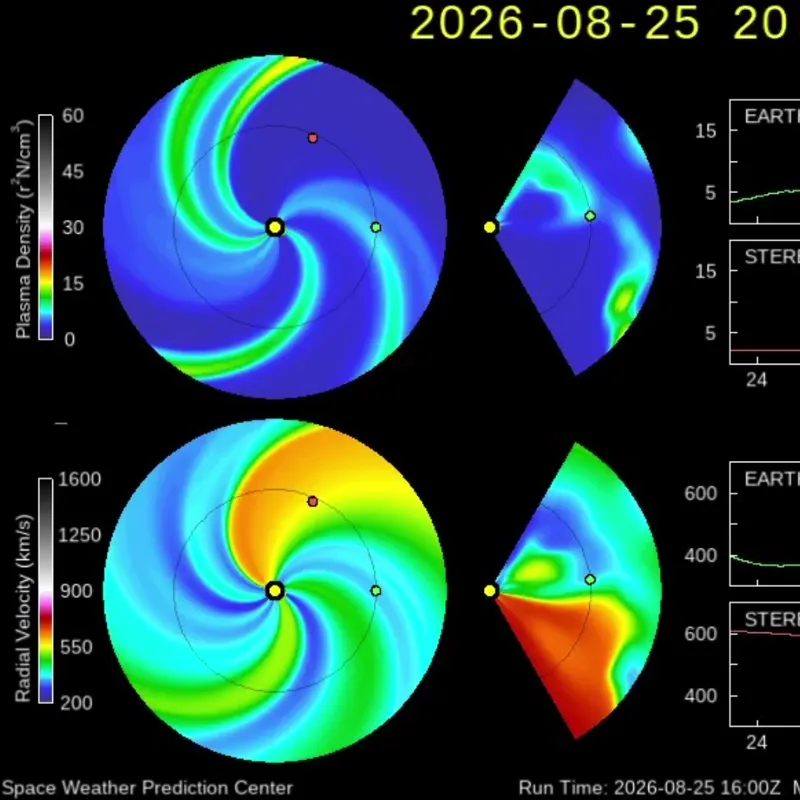
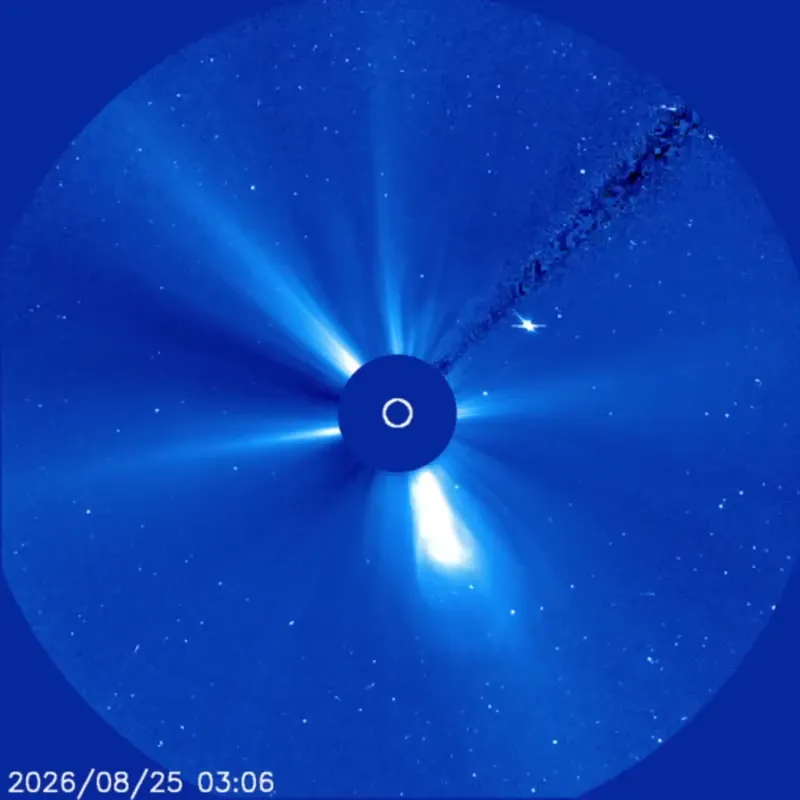
Today’s top story: A big chunk of solar stuff is heading our way! The M7 flare that active region AR4513 blasted out at 10:02 UTC on August 25 hurled a coronal mass ejection (CME) into space. After modeling and analysis, specialists have now confirmed it is coming to Earth. They anticipate arrival by August 28. And AR4513 may not be finished. The region now sits almost dead center on the solar disk, and it keeps its beta-gamma-delta magnetic complexity, the most volatile configuration there is. From that position, any CME it produces stands a good chance of heading straight for us. Here’s the tantalizing part. An early arrival could coincide with the lunar eclipse. Shall we see a red moon and auroras together? We have seen a red moon immersed in a green auroral display before. Stay with us for the results!
Past 24 hours on the sun
Sunspot regions: Our sun keeps displaying four numbered sunspot regions on its Earth-viewed side.
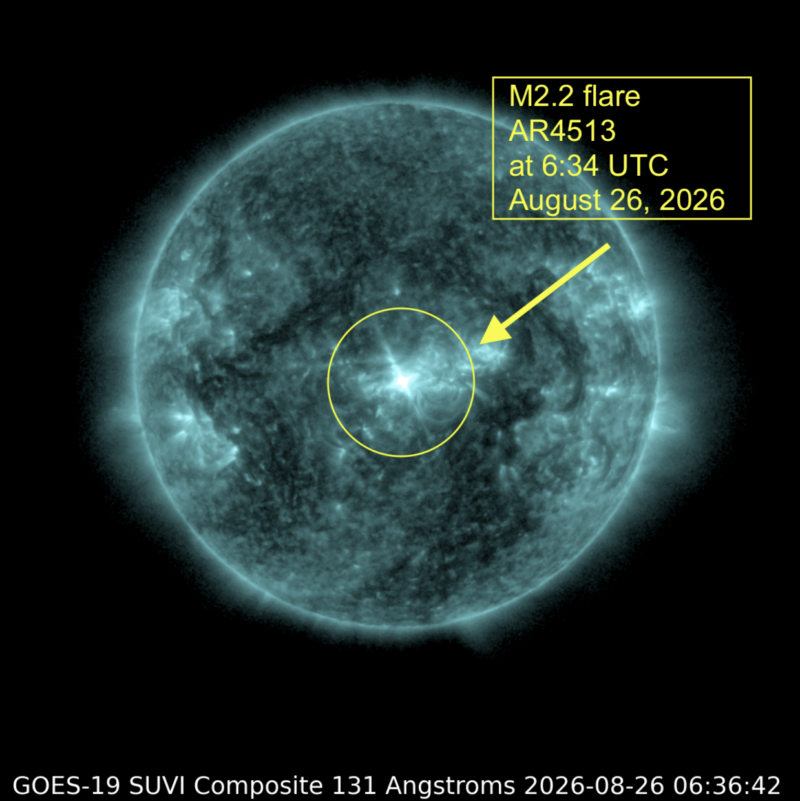
- AR4513 (beta-gamma-delta): This region continues to carry the strongest magnetic complexity on the disk. Today it showed reduced flare production. Even so, it stayed at the top of the flare list.
- AR4515 (alpha): No important changes to report here. This region stayed stable during the period.
- AR4516 (beta-gamma): This region continued growing in its trailing spots. It now shows a beta-gamma configuration, which reinforces the chances for bigger flares. However, it sits close to the northwest horizon and is ready to depart to the far side. It could still deliver a bigger flare at any moment.
- AR4517 (beta-gamma): This region joins the group with stronger configurations. It continued growing in both its leading and trailing spots, and it developed a gamma magnetic complexity.
Blasts from the sun? A C4.7 flare at 12:58 UTC on August 25 hurled plasma into space. Review is ongoing to detect any Earth-directed component of that CME. Meanwhile, all eyes stay on the chunk of solar stuff arriving by August 28. Given AR4513’s near-central position, observers will watch any blast from this region closely for Earth-directed material.
Past 24 hours in space weather
Solar wind: Solar wind speeds continued at low levels through the period. Forecasters reported no significant space weather.
Bt, Bz and magnetic coupling: The interplanetary magnetic field (IMF) reported weak strength. Meanwhile, the Bz component pointed northward during most of the period. Then, at around 2 UTC this morning, August 26, it began shifting between north and south orientations. A northward Bz, or one that flips quickly, is unfavorable for aurora production.
Earth’s magnetic field: The field stayed very quiet throughout the period, with Kp values of just 0-1. At the end of our observation period, the Kp index sits slightly above level 0.
What’s ahead? Sun–Earth forecast
Flare activity forecast: Forecasters continue expecting moderate levels through August 26 and 27. Today, the chance for M-class flares holds at 55%. Likewise, the chance for an X-class event stays at 10%. AR4513 remains the main player with its beta-gamma-delta complexity. But it has company now. Both AR4516 and AR4517 developed a beta-gamma complexity today, so they may contribute stronger flares too.
Geomagnetic activity forecast:
- August 26: Anticipate mostly quiet conditions (Kp 0-2) for the rest of the day. Background solar wind will prevail with no significant drivers.
- August 27: Late in the day, fast solar wind from a coronal hole might lift activity to unsettled-to-active levels (Kp 3-4). The chance of G1 (minor) storm intervals (Kp 5) increases as that fast wind arrives. If the stream arrives on schedule, auroras may appear over Seattle, Minneapolis, Edinburgh, and the Scottish Highlands.
- August 28 (extended outlook): G2 (moderate) storms are possible. The CME impact from the M7 flare should combine with the coronal hole stream, which peaks the same day. Forecasters expect active to storm conditions (Kp 5-6). Aurora watchers across northern Europe, northern Canada, and the northern tier of the United States should stay alert for possible displays.
- Sun news August 25: Sunspot region roars with 5 M flares
- Today’s top story: After a quiet few days, promising sunspot region AR4513 roared back to life over the past 24 hours! It fired all 16 of the past day’s flares, including an impressive five M flares. The largest was an M7, peaking at 10:02 UTC on August 25 and triggering an R2 (moderate) radio blackout over Africa. This sunspot region is finally unleashing the potential of its beta-gamma-delta magnetic complexity, the most volatile configuration there is. Notably, it’s now sitting almost dead center on the solar disk. So if the powerful M7 flare hurled a coronal mass ejection (CME) into space, a good portion of it could head straight for Earth. Specialists are analyzing the event now. Stay with us for the results!
- Past 24 hours on the sun
- (11 UTC August 24 – 11 UTC August 25)
- Flare activity: Solar activity jumped to high levels, thanks to five M flares. In total, the sun fired 16 flares during the period: 5 M flares, 9 C flares, and 2 B flares.
- Strongest flare: An M7.0 from AR4513 peaking at 10:02 UTC on August 25. The event provoked an R2 (moderate) radio blackout centered over Africa.
- Second strongest: An M2.0 at 1:26 UTC on August 25. It produced an R1 (minor) radio blackout over the Philippine Sea.
- Other M flares: An M1.8 at 19:36 UTC on August 24, with an R1 (minor) radio blackout over the Pacific Ocean west of Central America. Then an M1.0 at 4:02 UTC on August 25, producing an R1 (minor) radio blackout over the Philippines and Southeast Asia. Finally, another M1.8 at 6:40 UTC on August 25, with an R1 (minor) radio blackout over the southeast coast of India
- .
- Lead flare producer: AR4513 fired all 16 flares tracked over the period.
- Sunspot regions: Currently, the solar disk displays four numbered sunspot regions on the side we see from Earth.
- AR4513 (beta-gamma-delta): This region reawakened during the period, and did so dramatically. It was the only flare producer, delivering all five M flares. It also now sits near the disk’s center, which means its eruptions could affect Earth.
- AR4515 (alpha): This sunspot region stayed stable during the period.
- AR4516 (beta): This region reported growth in its trailing spots. Even so, it produced no flares.
- AR4517 (beta): This region continued growing in both its leading and trailing spots. Still, it produced no flares.
- Blasts from the sun? Observers are concentrating their attention on the five M flares from AR4513, especially the M7.0. Review is ongoing to find any Earth-directed component among the coronal mass ejections (CMEs) hurled into space during those events. Given the region’s near-central position, an Earth-directed component is a real possibility this time.
- Past 24 hours in space weather
- Solar wind: Solar wind speeds averaged at low levels through the period. No significant space weather was reported.
- Bt, Bz and magnetic coupling: The interplanetary magnetic field (IMF) stayed weak, showing only a slight increase at the end of our observation period. Meanwhile, the Bz component pointed northward the whole time. That orientation is unfavorable for aurora production.
- Earth’s magnetic field: The field stayed quiet-to-unsettled throughout the period, with Kp values of just 0-3. As a result, aurora sightings stayed limited to the far northern auroral zone: Iceland, northern Scandinavia, northern Alaska, and Canada.
- What’s ahead? Sun–Earth forecast
- Flare activity forecast: Forecasters expect moderate levels to continue over August 25 and 26. Today, the chance for M-class flares increased to 55%, up from 45% yesterday. Likewise, the chance for an X-class event rose from 5% yesterday to 10% today. With the M7.0 now on the books, those odds may climb further in the next update. All eyes stay on AR4513 and its beta-gamma-delta complexity.
- Geomagnetic activity forecast:
- August 25-26: Anticipate quiet conditions (Kp 0-2) for now. Background solar wind will prevail with no significant drivers. However, this outlook does not yet account for any CME from the M7.0 flare. Watch for updates.
- August 27: Late in the day, fast solar wind from a coronal hole might lift activity to unsettled-to-active levels (Kp 3-4). The chance of G1 (minor) storm intervals (Kp 5) increases as that fast wind arrives. If the stream arrives on schedule, auroras may appear over Seattle, Minneapolis, Edinburgh, and the Scottish Highlands.
- August 28 (extended outlook): The coronal hole stream is more likely to peak on this day, and solar wind speeds should increase to elevated levels. Forecasters expect unsettled-to-active conditions (Kp 3-4), with a chance of G1 (minor) storm intervals (Kp 5). Aurora watchers across northern Europe, northern Canada, and the northern tier of the United States should stay alert for possible displays.